Say Something Before They Learn It From the Internet: Dads, Sons, and the Body Talk We Keep Skipping
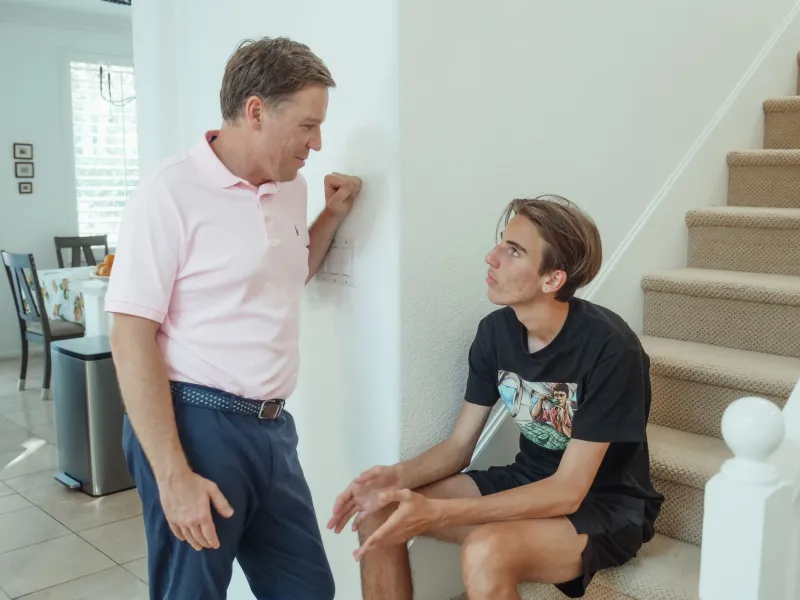
Ask a father when he last talked to his son about his body — honestly, specifically, out loud — and watch him stall. Most men can't remember the conversation because it never happened. We've built an entire cultural machinery around talking to daughters about their bodies, complete with hand-wringing op-eds and school curricula, while sons get a shoulder clap and a vague "you're growing like a weed."
Meanwhile, teenage boys are marinating in a content ecosystem that would make a 1980s gym teacher blush: shredded influencers, edited physiques sold as attainable, and an algorithm that learns within days whether a kid feels small. The silence at home isn't neutral. It's a vacuum, and vacuums get filled.
What the Silence Costs
Family therapists who work with adolescent boys describe a consistent pattern: boys absorb their fathers' relationship with their own bodies without a word being spoken. Dad skips the pool party, and the son learns that bodies get hidden. Dad makes a joke about his "dad bod" in front of company, and the son learns that men preemptively apologize for their flesh.
"Boys don't listen to what fathers say about bodies," says one licensed family counselor we spoke with, who asked to use only her first name, Elena, because her practice includes several well-known clients. "They watch what fathers do. The most common inheritance I see is a father who was shamed, who never processed it, passing it down like a heirloom nobody wants."
The numbers back the anecdote up. Surveys consistently show that a substantial share of adolescent boys report body dissatisfaction, and rates of muscle dysmorphia — the pathological belief that you're not big enough — have climbed alongside the rise of fitness influencer culture. Boys are not immune to body shame. They're just trained not to mention it.
The Dads Who Broke the Pattern
The good news: some men are deliberately ending the cycle, and their stories are more instructive than any parenting manual.
Take Ray, a 39-year-old electrician from Michigan who grew up in a house where his father called him "husky" from age nine onward. When his own son turned twelve, Ray made a decision: no nicknames for his body, no jokes at his expense, and — the hard part — no jokes at Ray's own expense, either.
"I had to stop calling myself fat in front of him," Ray says. "That was harder than quitting smoking. Because I'd been doing it my whole life and I didn't even hear it anymore."
His rule now: bodies are discussed the way you'd discuss a car. Function over aesthetics. What it can do, what it needs, what hurts. "We talk about sleep like it's a performance enhancer, because it is. We talk about food like fuel. He's never once heard me rank a body, his or anyone else's."
Then there's the other end of the spectrum. James, 47, grew up in a household where nudity was completely ordinary — European parents, communal baths, no big deal. He assumed his own son would inherit that ease. Instead, the kid got his body education from TikTok at age eleven, and James found himself playing catch-up.
"Being comfortable in your own skin at home isn't the same as preparing a kid for the internet," he admits. "Normalcy at home helps. But you still have to name the machine. You have to say, out loud, that those bodies online are lit, posed, filtered, and often surgically purchased. If you don't say it, the algorithm won't."
The Talk Nobody Scripted
Here's the uncomfortable truth: there is no cultural script for the father-son body talk. We have scripts for the birds-and-bees conversation, awkward as they are. For bodies — how boys feel about theirs, what they're seeing online, why their chest looks different than the guy's in the locker room — nothing.
So build the script. Therapists suggest starting with three moves:
One, audit yourself first. Your son will mirror your self-talk. If you announce your flaws at every beach trip, he's taking notes.
Two, name the filter. Have one explicit conversation about edited bodies online. Not a lecture — a shared scrolling session where you point out what's fake. Do it before middle school, not after.
Three, answer the weird questions without flinching. Boys ask strange, specific things about their changing bodies. The flinch is the lesson. The non-flinch is the lesson too.
Why This Matters Beyond the Household
We talk constantly on this podcast about body confidence as an adult project — the retreats, the performers, the gym mirrors we've all made peace with or haven't. But confidence isn't built at thirty. It's built at eleven, in a kitchen, by whether a man's father treated his own body like something worth respecting.
The dads breaking the cycle aren't doing anything heroic. They're doing something almost insultingly simple: they're saying things out loud. "Bodies change." "That photo's edited." "You don't have to be big to be good."
Two sentences, said at the right time, could save a kid a decade of quiet shame. That's not a parenting hack. That's the whole job.